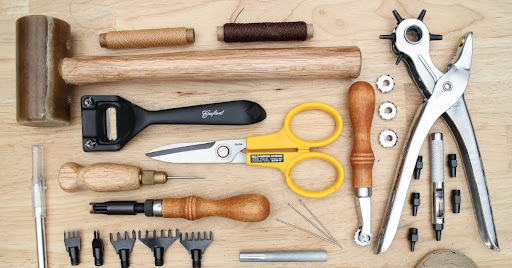
How Do You Choose the Best Upholstery Tools for Different Types of Furniture Projects?
Upholstery tools are required in households with upholstered furniture when stripping, repairing, constructing, or finishing is needed. Most people are probably unaware of the inherent intricacies that can be found within the many upholstery tools that exist. Upholstery tools Aren’t merely functional. They make possible the creation of upholstered pieces; after spending a substantial amount of time at the workbench, they become an extension of the hands.
All aspects of a typical upholstery job will be covered in this blog, including the materials found within the seat, the supplies used, and professional-level supplies available for purchase.
What are the Must-have Tools for an upholstery project?
All the upholstery tools and supplies serve a unique function. By selecting an inappropriate tool to complete your task, you are wasting time, damaging the chair frame, and undermining the plan for the completed project. These tools are the instruments you will refer to in nearly every job, whether you are in a professional shop or restoring a single chair in your home.
For Attaching Material:
- Sewing Machine
A quality sewing machine is vital as soon as you begin to sew piping, upholstery, or any other panel that you have sewn together. Not all home machines can handle sewing materials because the upholstery material can be quite heavy, very bulky, and requires an even amount of pressure on the needles to maintain its tension. The machine that you choose must be able to sew through multiple layers without skipping stitches.
- Staple Gun
The staple gun is believed to be one of the most standard auto upholstery tools in today’s world. All three types- electric, pneumatic, and manual serve a place and depend on the amount of product being crafted as well as the type of furniture being used. It is also very important to use the correct size staples based on the application.
- Air Compressor
For those who do regular upholstery, a pneumatic stapler with a compressor is considered the professional standard. Using a pneumatic gun is much faster, more consistent, and much less tiring on your body during long projects compared to using a manual stapler.
- Upholstery Hammer
Next to the upholstery tools you need is a Hammer. With a lower weight and more accuracy than that of a regular carpenter’s hammer, your standard upholstery hammer is constructed specifically to drive tacks, secure springs in position, and perform other tasks in tight spaces. A magnetized face allows you to place small tacks using only one hand, which can save considerable time and effort when you become accustomed to this technique.
For Stripping and Prep
- Tacks
Traditional upholstery uses tacks for attaching webbing, securing twine, and holding temporarily onto a piece of fabric until final fastening occurs. Different sizes exist for different applications. A new upholstery worker will commonly make the mistake of not using the correct size of tack, which can significantly alter the final appearance.
- Staples
Although staples have come to replace tacks for upholstery fabric installation in modern upholstery tools, it is important to remember that not all staples are created equal. The holding power of each staple varies based on its size rating, crown width and leg length. Therefore, the use of inferior or incompatible staples is one of the most common causes of fabric being pulled away from the frame, a condition that can be avoided by simply knowing what type of staple to purchase for your project.
- Pliers for upholsterers
When working with upholstery, a variety of pincers or pliers can be useful. They are often helpful for stripping materials, too, including anything I use on a daily basis. At workshops, you will find the kind I use every day; the red Facom pliers are by far the most used for removing.
For Measuring and Cutting
- Manual Tools
An upholsterer’s toolkit includes a small number of unique tools that cannot be replaced with any other option: tack lifters and mallets to remove tacks, webbing stretchers to apply tension to jute webbing, staple removers and ripping chisels for disassembling old furniture, and spring stretchers to install sinuous springs.
- Scissors and Cutting Tools
Quality upholstery tools like fabric scissors, an electric carving knife, a foam cutter and a seam ripper finish off our cutting tools. Investing in quality will give you an immediate return. You’ll get cleaner cut edges, won’t have as much fray, and will be able to complete your sewing projects more quickly.
- Pins, Curved, and Straight Needles
Traditional upholstery employs different types of needles, including straight and curved, of all different lengths. Needles may be used for sewing springs, stitching edge rolls, and closing the cover. Upholstery is made up of long Mattress needles as well as both Curved and straight, with most being between 10 cm and 30 cm; Long Mattress Needles are particularly essential in executing the bridle tie stitching, edge roll stitching, and through stitching on traditional padding.
Why Is It Important To Have A Trustworthy Supplier?
Having the right upholstery tools and materials is only useful if you can find them; sourcing is part of the skill. Good springs, quality jute webbing, professional-grade foam, and proper upholstery fabric are not always easy to find in a general hardware or craft shop.
It takes time and experience to learn how to identify the best quality products versus the many inferior alternatives available. You first need to know what to look for and how to ask the right questions so you don’t end up with something less than you expected. And for this, Valley Studio is all you need.
Wrapping It All Up!
To save some bucks, repairing your furniture at home can be a great way if you have the right upholstery tools. You do not have to call any more people for a minor scratch. By knowing about each tool, you are more likely to maintain good furniture for longer.